Decide What You Will Be Known For
Most agencies set an awards direction. Few find the right one first. Here is how to map the reputation you are chasing, then work back to the shows that build it. Part one of two.
Cannes wrapped this week. Somewhere in your feed is an agency you rate, holding more metal than you, and the same thought lands in a lot of founders' heads: next year, we go harder on awards.
So you tell the team. We are going to win more. Everyone nods. By August it is quiet again, and the entry list looks a lot like last year's.
"Win more" is the problem. It is a wish, not an ambition. A team cannot organise around it, and a budget cannot be built from it. Before the entries, before the budget, there is a step most agencies skip. Decide what you actually want to be known for.
Here is the awkward part. You already know this. You do it for clients every week. You would not let a client spend on a campaign without first deciding what they stand for and who they are talking to. You make them do that work before they spend a cent. Then awards season arrives and your own shop enters on instinct and last year's list. The discipline you sell is the discipline you skip.
Awards build a reputation. Pick which one.
Awards are not the goal. They are how you build a specific reputation, and different shows build different ones.
A wall of D&AD Pencils says your craft is world class. A run of Effies and a WARC effectiveness ranking says your work sells, which is the language a CMO and a procurement team already speak. Cannes Lions buys broad creative fame. Spikes and the regional shows build standing in a market you want to own. An Independent Agency of the Year title says something specific about who you are and how you win.
Those are different reputations. They attract different clients, different talent, and different fees. Chasing all of them at once is how a finite budget produces nothing anyone remembers.
The first job is not picking shows. It is picking the reputation. The same call you would force a client to make.
The right direction is what earns buy-in
This is where it pays to slow down. A direction handed down from the top gets polite agreement and quiet neglect. A reputation the team helped define, and understands the reason for, is something they will chase through a brutal entry season.
People commit to a dream they had a hand in shaping.
"Win more" is nobody's dream. "Become the most awarded independent in the region within three years, because that is what wins the clients we want" is something a team can pull toward together.
The agencies that win most have a defined identity, and they say it out loud. Alexander Schill, the global creative chief at the independent Serviceplan group, names theirs in three words: "independence, internationality, and an uncompromisingly creative approach." Tony Bradbourne built Special into a repeat global Agency of the Year on a tighter pairing. On effectiveness and creativity, he says, "We value the two in equal measure."
Neither of those is "win more." Each is a profile, chosen on purpose, and small enough to repeat in a corridor.
The freedom to choose the long game
An independent has an advantage here that the networks envy. Chris Howatson, who built one of Australia's most awarded independents, ties it together plainly:
"Because we are independent, we have no shareholders. No quarterly earning calls. There's no need to find 10% growth every year."
That freedom is exactly what lets a small shop pick a long-game reputation and hold to it. A client of Motion Sickness, the Auckland independent, put the same idea in creative terms: the agency has "a fearless approach to new ideas, free from the need to get things signed off by the network." A clear identity is easier to hold when no one outside the room gets a vote.
Work back from the reputation
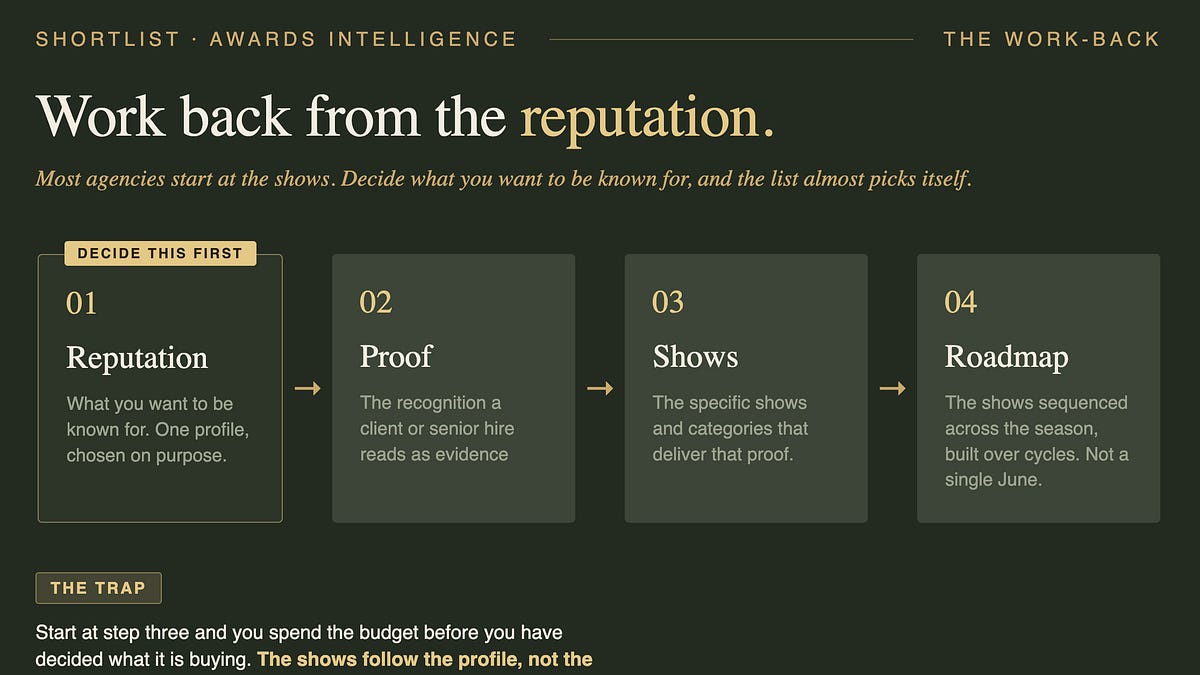
Once the ambition is set, the rest is a chain you build in reverse.
Start with the reputation you named. Translate it into the proof that signals it, the kind of recognition a client or a senior hire would actually read as evidence. Map that proof to the specific shows and categories that deliver it. Then sequence the shows into a roadmap, because a reputation is built over cycles, not in one June.
A worked example. Say you run a boutique in Singapore and the ambition is to win effectiveness-led clients in your home market. So the roadmap leans on the Effies and the regional effectiveness shows, with one or two craft entries a year to keep the creative reputation warm. Change the ambition to global creative fame and the same agency produces a completely different list. The shows follow the profile, not the other way around.
Aaron Starkman, who runs Rethink, describes the execution end of this once the goal is fixed:
"We set agency-wide goals every year. Let's say we set out to win Independent Agency of the Year in Cannes. We identify the number of awards needed, and then we go after it."
The goal is not "win more." It is a named title, a specific profile. The number of entries is reverse-engineered from it. This year Rethink was named both Independent Agency and Independent Network of the Year at Cannes. The method is not a theory.
A chosen profile beats a defaulted one
It was Mediaplus Munich that topped the WARC Media 100 in 2025, ahead of every network office in the world. Not a small shop: the German operation it sits in runs over a thousand people. But it is independent, and that is the point. It did not get there by outspending WPP or Publicis. It decided what to be known for, effectiveness and media, and chased that profile deliberately, climbing from 14th in 2023 to 3rd in 2024 to 1st in 2025. A reputation built over cycles, not in one June.
The lesson is not the headcount. It is the deliberate choice. A network office inherits its positioning from a global template. An independent picks its own. A thirty-person shop and a thousand-person one share that freedom, even if they share little else. The profile does the work. Independence is what lets you choose one.
Three years is the horizon, not the plan
Here is the fair objection. Three years is a long time to a thirty-person shop deciding where this quarter's money goes. A reputation you reach in 2029 does not pay for the new business meeting next month.
It does not have to. The three-year profile is the destination. You win in quarters. The reputation breaks into a season of named shows, each entry a near-term target that ladders up to the annual goal and then to the three-year one.
Done right, the build pays off long before the headline title arrives.
Talent see momentum and stay. Clients read the early wins as proof. An acquirer, if that is ever the plan, sees a track record instead of a claim.
That quarter-by-quarter build, the one a small shop can start on Monday, is the next piece. For now, the work is upstream of all of it.
Do one thing this week
Write one sentence and finish it honestly:
"In three years, we want to be known as the agency that ______, because ______."
If you cannot complete it, that is the work to do before you open a single entry form. If you can, you have just written the brief for your whole awards program, and the show list almost picks itself.
Setting the ambition is yours to do. The work-back is where Shortlist comes in. It maps your profile to the shows and categories that build it, scores where you have a real shot, and lays out the roadmap across the season. You set the dream. It builds the route.
Next: how a small agency turns a three-year reputation into quarterly win targets, without blowing the budget in the first season.
Your final edit, brought forward as fast as possible.
30+ shows. Unlimited entries. The judgment stays yours.
Start free trial