The Networks Don't Own the Media 100
Independents can - and do - regularly outperform network offices.
Most independent agencies have never heard of the WARC Media 100. The holding companies have. WPP cites it in filings to the SEC. Omnicom's chairman puts it in his letter to shareholders. Havas calls WARC "the global authority on marketing effectiveness" in its audited accounts. At WPP's 2024 AGM, the CEO explained it to the room: "WARC is an aggregation of all the top award shows, things like Cannes Lions you may have heard of, or the One Show or the Effies." He added that the rankings "are very important to our clients."
So the biggest companies in the industry treat one scoreboard as the measure of awards performance, and report their standing on it to investors.
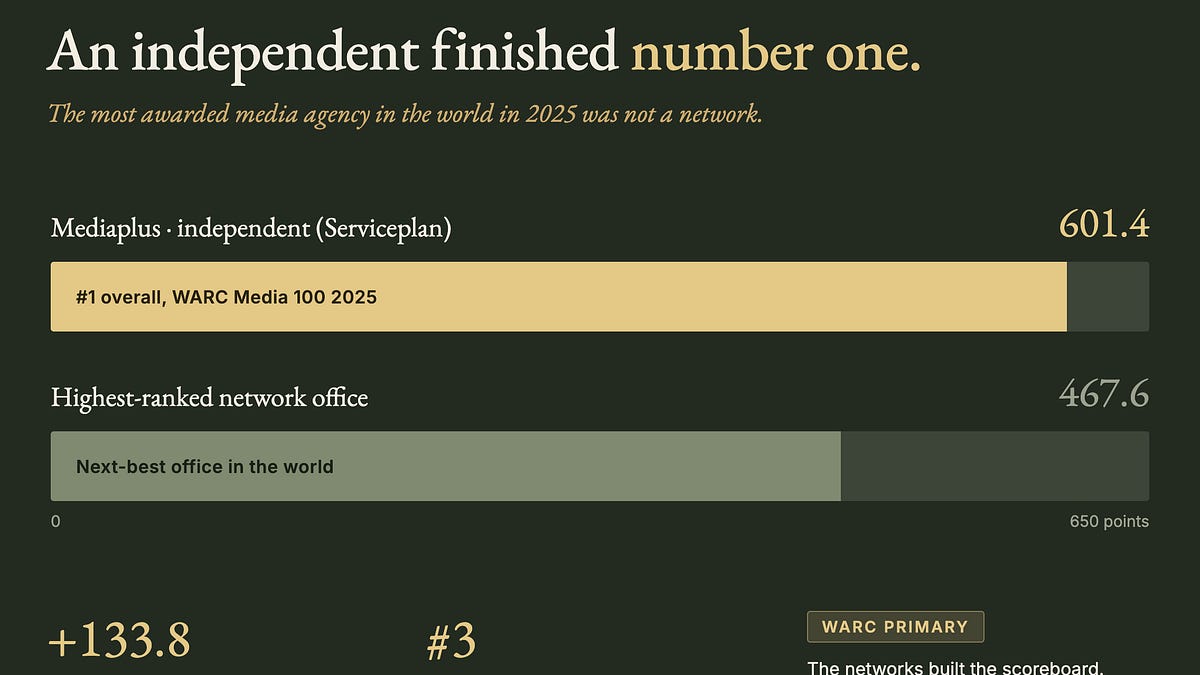
Here is the part they tend not to dwell on. The agency that finished first on that scoreboard in 2025 was not one of theirs. It was Mediaplus, the media arm of Serviceplan, the largest independent, partner-managed agency group in Europe.
An independent was the most awarded media agency in the world, and not by a hair, it outscored the nearest network office by more than 130 points.
In 2026 it still sits third, ahead of offices from Mindshare, PHD, OMD and EssenceMediacom.
The networks built the scoreboard. They do not own it.
Why an independent can win this
Two features of the ranking explain how, and both are published.
WARC ranks by office, not by holding company. PHD London competes as PHD London, not as all of PHD or all of Omnicom. The unit is a single office's body of work. That is a contest an independent can enter on equal terms.
And the scoring caps the hero campaign. Medals convert to points on a fixed scale: a Grand Prix is worth 10, a Gold 6, a Silver 4, a Bronze 2, each multiplied by a show weighting between 1 and 5. But WARC caps the points one campaign can win at any single show at ten, "in order not to over-reward campaigns that have won many awards at a single awards scheme." And across all competitions, one campaign's total contribution is capped at 200.
No single celebrated piece can carry an agency to the top.
That second rule is the opening. A network's budget advantage cannot be concentrated into one giant win, because the cap forbids it. What climbs the ranking is method: enter the right shows, across the season, with work that places. Method is the one variable a focused independent controls as well as any network. The holding companies do not always get it right.
What the top is built on
PHD London tops the 2026 Media 100, and not on one campaign. Its winning work runs wide: the V&A Museum's "If You're Into It, It's In The V&A," Barbie's "Pink Sky Thinking," British Heart Foundation, Škoda's Reddit work, medals taken across the Festival of Media, the M&M Global Awards, the Campaign Media Awards and Cannes. The cap means even the V&A campaign, which won at several of them, can only carry the agency so far. The rest of the score came from the next campaign, and the one after that.
Mindshare Shanghai made the same point over five years: top 20 every year from 2021 to 2025, first in 2021, and, by every publicly available record, without a Cannes Lion in any of them.¹ A focused portfolio, not a trophy cabinet built on one show.
WARC publishes which shows feed the ranking, from the Festival of Media and the M&M Awards to the media categories at the Clios, D&AD, Spikes Asia and the Effies. What it does not publish is how much each is worth. The weightings are, in its words, "proprietary." You do not need them. The weights set the order. The caps set the rules.
Why this matters if you are building toward a sale
Many independent owners are working toward one outcome. An exit. This is where the scoreboard stops being about vanity.
The WARC 100 is the awards scorecard the buyers keep on themselves.
WPP reports its WARC standing to the SEC. Omnicom's chairman puts it to shareholders. Havas cites it in its accounts. An independent that ranks is making its case to every potential acquirer in the acquirer's own language, on the acquirer's own measure, before anyone opens a conversation about price.
A trophy on the shelf does not move that conversation. A standing position on the table the buyers themselves cite, year after year, does. And the table is closer than the names on it suggest: the tenth-placed office in 2026 scored around 150 points, and an independent has already been first.
The move
It is worth taking count before you set next season's budget.
Not the trophies on your best piece, but how many separate pieces actually placed, and at how many shows.
That number is what the ranking rewards, and what a buyer can read.
The agency that bets the season on a single campaign is optimizing for the photo. The agency that builds a portfolio that converts is optimizing for the table. The networks built that table. They do not own it. An independent was just number one.
Shortlist tracks jury composition, scoring patterns, and entry intelligence across 30+ shows. gotshortlisted.com
¹ WARC ranks by individual office; the figures are Mindshare Shanghai. No Cannes Lion is attributed to the office in any publicly accessible record across 2021–2025. Cannes's searchable database is subscription-gated, so this rests on the public record rather than a database confirmation.
Your final edit, brought forward as fast as possible.
30+ shows. Unlimited entries. The judgment stays yours.
Start free trial