The Off-Season Playbook
Seven principles for running an awards program in the weeks when nothing is due to an organizer. One chapter each, with the full article behind every one.
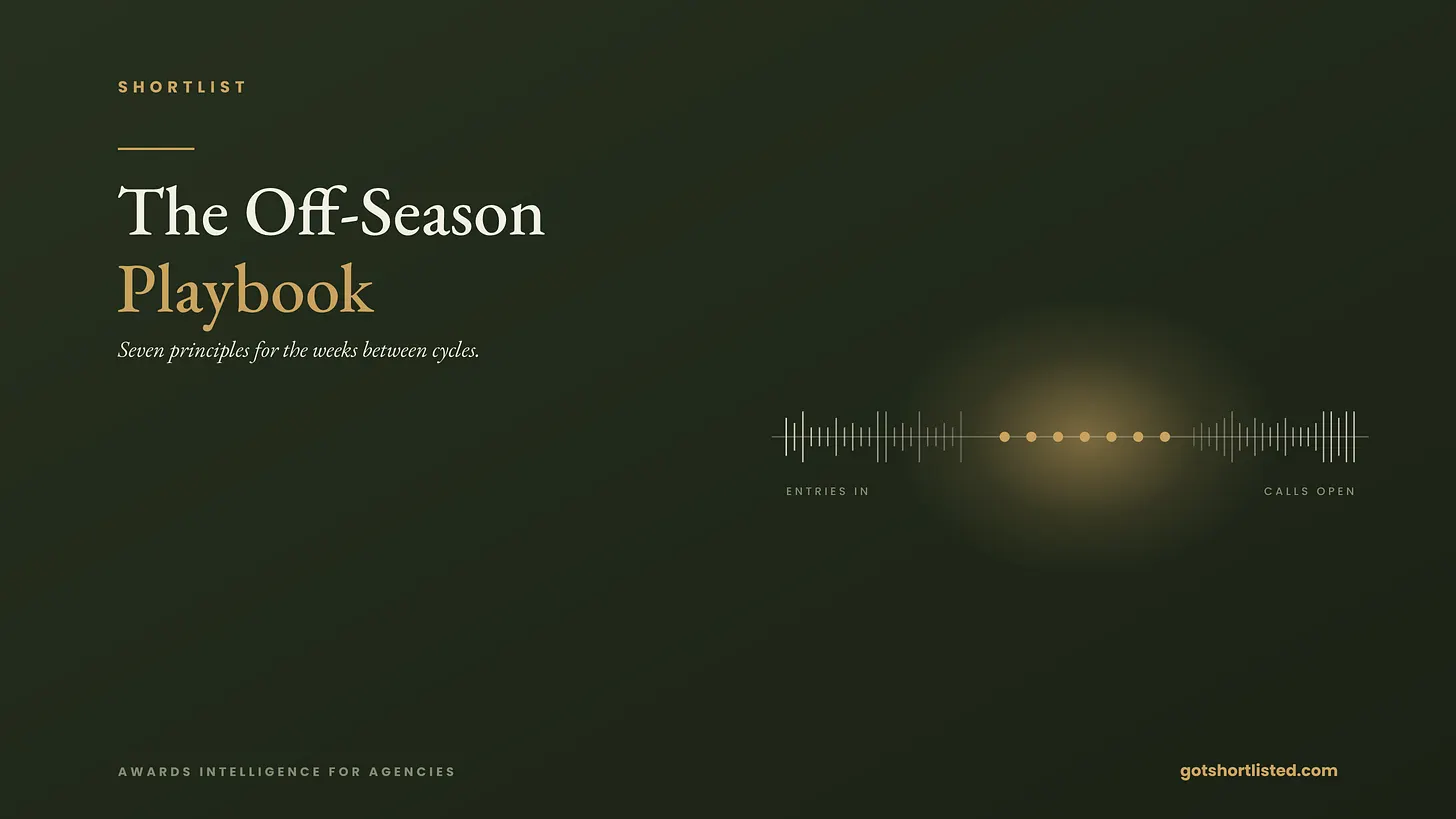
Campaign's Agency of the Year entries closed on 4 September, and the shortlists come out on 28 October. The 2027 calls start opening nine days later: the Festival of Media Asia-Pacific Awards take entries from 6 November.
That puts most of the industry in the same position for the next few weeks. Last cycle's work is in, next cycle's deadlines are not yet close, and next year's calendar is not yet decided. Everything below belongs in those weeks. None of it belongs in deadline week, which is where most of it currently happens.
These seven principles come out of a program that got most of them wrong first. More than a thousand entries over a decade, three hundred wins by 2020, and years of picking shows before anyone had decided what the agency wanted to be known for. They are in the order I wish someone had handed them to me in 2012.
One. Be half cynic and half idealist, at full strength
The cynic knows the game is a game. Knows who is on the jury and who wants to go to Cannes. Knows that a category with half its usual entries is a soft target this year and a stacked one is a lottery ticket. Knows the shortlist videos are not all getting watched by the senior people, so the first ten seconds have to do the work.
The idealist remembers what the awards are for. They give an account team a spotlight for work they poured a year into. They give a strategist a credential that outlasts the job.
A program run by pure idealists loses. It enters the work everyone loves, in the categories that sound prestigious, described the way the team would describe it to itself. A program run by pure cynics burns out, and it takes with it the people who were actually good at finding the angle.
Hold both and you get someone who will do the unglamorous, calculating work of reading a jury, precisely because they believe the thing being entered deserves to win.
The one thing to do differently. Read every draft twice, with two different jobs. Once as the juror who is out to get you: where does this get killed. Once as the coach: where is the untapped potential, and what is the single change that moves it. Neither read is worth much without the other.
Two. Build the machine, not the entry
Mindshare China, 2014. No process at all. Someone remembered in September that entries were due, a folder got opened, and whoever was around that week wrote the drafts. It won a gold, a silver and two bronze, and somehow Agency of the Year for Smarties China.
What produced more than a thousand entries and three hundred wins over the following years was not better writing. It was five stations, run in the same order every cycle: collection and screening, first drafts worked as angles rather than entries, a review cycle staffed by people who have actually judged, the two-minute video script, then final edits.
The order is the whole point. Every station kills work the next one would otherwise waste time on. Screening kills the campaigns with no story before anyone drafts an angle. The review cycle kills the cases a juror would reject before you script them. The script kills the entries that cannot survive two minutes before you write the long version.
Most agencies spend almost all their time in the last station and almost none in the four before it. That is exactly backward, and it is why so much award effort goes into polishing entries that were never going to place.
None of it needs network headcount. A twenty-person shop runs the same five stations at a smaller size. They do not need to be elaborate. They need to happen in order.
The one thing to do differently. Write the five stations on one page and put a date against each one for the next cycle, now, while nothing is due. The alternative is the four early stations collapsing into a single adrenaline week because nobody scheduled them.
Three. Screen the slate before you spend anything on it
A regional awards council, 2016, reviewing nine entries from five markets before the region paid to develop and submit them. One seat on it was mine.
Six of the nine came back a flat no. One a conditional no, one a qualified yes after heavy line edits, one a clean yes. Killing six of nine saved between £1,284 and £1,560 in entry fees alone, before the professionally produced case films that never got commissioned.
Four questions did most of that work, entry after entry. Whether someone outside the market can understand the result without translation. Whether the strategy section connects to the objective and the execution, or reads like three sections stapled together. Whether the work is genuinely new, or effective media planning already covered by the category brief. Whether the budget is disclosed at all.
Then the complication. Cross-checked against the published shortlist, none of the nine placed. That includes the clean yes.
Judgment reduces waste. It does not guarantee a trophy. Anyone selling the second claim is selling something else.
The one thing to do differently. Run the whole slate against those four questions in one sitting, before a word gets drafted, and say no out loud to the ones that fail. A no at this stage costs an afternoon. The same no after the fee and the film costs the cycle.
Four. Pick the room, not the label
Be honest about how the category actually gets picked. The case study is done, someone opens the entry form, scrolls to the dropdown, and picks the option that sounds closest to what the campaign was. Thirty seconds, tops. Then the fee gets paid.
That call gets less thought than anything else in the entry and does more to decide the outcome than almost anything in the case study. A category is three things stacked on top of each other. It is a jury, with its own specialism and its own instincts about what counts as strong. It is a competitive set, meaning every other agency that also picked that shelf this year. And it is a definition of proof, because each category rewards a specific kind of evidence.
The broadest, most prestigious-sounding category feels like the safe pick. It is the opposite. Broad categories draw broad fields, by definition, because every agency has the same instinct at the same moment.
Most entries that miss the shortlist were not bad entries. They were good entries, read in the wrong room.
The one thing to do differently. Pull the full category list and read every description, not the titles. Titles are marketing. Mark which categories are broad and which are narrow, work out who else will be sitting in each room this cycle and what proof they came to reward, then pick on odds rather than on how the name looks on a cover page.
Five. Write an argument, not a report
Fluent prose is free now. Everyone entering the show has something that writes clean sentences on command, which means fluency has stopped signaling anything. The entries still losing are not losing on sentence quality.
Picture the juror reaching your case film after sixty others in a single day. They are fried, and in many shows the written entry is not even the first thing they see. It is what they turn to when the room is debating whether to shortlist you and somebody wants to check a detail before arguing either way.
So underneath its prose, an entry is a case built for one specific skeptical reader. It needs four parts, in the order that reader checks them.
- The claim. Specific enough to be wrong. If it could describe half the entries in the room, it is not a claim yet.
- The mechanism. The line from the insight, to what got built, to why it worked, traced rather than implied.
- The proof. Checkable evidence a juror could verify if they wanted to.
- The so-what. Why any of it matters beyond your own satisfaction.
Most fluent-but-forgettable entries die quietly at the claim, long before anyone gets near the numbers. Vague claims are easy to write fluently. Specific ones are not, and that difficulty is exactly the signal a juror is trained to notice.
The one thing to do differently. Before drafting, write the four parts as four separate sentences. Not prose. One for the claim, one for the mechanism, one for the proof even if it is a placeholder for a number you do not have yet, one for the so-what. If any of the four is hard to write, that is the actual problem with the entry, and drafting will not fix it.
Six. Get a seat in the room
First jury, a local China festival, 2015. Showed up as an alternate, standing in for an MD who could not make it, knowing nobody in the room.
A few things become obvious fast once you are in there, and none of them are visible from the entry side. Juries are people. They are tired, they are reading the fortieth entry of the day, and in the shortlisting rounds a lot of them are not watching all three hundred videos themselves.
Which means the arguing matters more than the entry. When a jury lands on a winner it is often less about the single best piece of work and more about who in the room went to bat for what. Some judges arrive wanting to give medals. Some are proud to hold the line and hand out nothing. Learning to read which is which tells you more about your odds than any category description.
Once you have watched a room decide, you write differently. You stop writing for an imaginary panel reading carefully and start writing for a real one scanning fast and arguing later. You give your entry an advocate's ammunition: the one line a champion can repeat in a debate you will not be in.
Most people who want standing in the industry go looking for a stage, and it stalls. The seat runs the other direction. Judging is service, not spotlight, and shows are chronically short of experienced judges.
The one thing to do differently. Put your hand up for one jury or council seat that is realistically in reach. Regional programs, category-specific shows and industry bodies are short of judges almost all the time and far more open than any stage. You do not need a profile to get a seat. You need to be willing to read the work.
Seven. Price the cheap entries as research
The clean version of test-and-learn sounds obviously right. Enter the smaller, earlier shows, see what resonates with juries, then concentrate the budget behind whatever shows signal as the bigger deadlines arrive. Check the actual calendar and the sequence breaks. The flagship closes in early spring. The results that would tell you whether the instinct was right land weeks after the fee is spent and the work is locked.
So the early results cannot do the job most agencies quietly assign them. What they can do is two other things. They carry a trace of validation into rooms further down the calendar, since an early shortlist generates coverage before the bigger jury convenes. And they give you a real read for the back half of this year and for next year's flagship bet, decided months from now with this year's evidence in hand.
That reframes the whole season. It is not a loop you complete between January and December. It is a funnel across years, where this year's cheap entries are the research budget for the bet after next.
An early entry that does not place is not simply a loss. It is a data point, bought at a fraction of the flagship's cost, that tells you something true about where to spend the bigger money.
The one thing to do differently. Log every early-season result against the direction it validated or undercut, and read that log again at the point each later deadline opens rather than working from memory. The discipline only pays on shows where a genuine result is realistically in reach. A cheap entry that cannot plausibly win anything is not research, it is a fee.
Where this came from
Every principle here was published in full over the summer, one article at a time, and every one of them exists because a program I ran got it wrong first. Shows picked before the reputation was decided. Categories chosen in thirty seconds at the deadline. Entries polished long after screening should have killed them.
Shortlist is the attempt to hand a small team the parts of that decade that can actually be handed over. It reads a campaign, maps the shows and categories where there is a real shot, scores a draft the way a jury reads it, and shows where the untapped potential still sits. It will not win the award. It shortens the grind, and it catches what a tired writer missed.
Start a trial. Run one campaign through the whole workflow, from show and category directions to a scored draft, and see what it says about work you already know well. Seven-day trial, card required to start.
Or read the rest. The full run of articles on award program strategy, jury reading, entry craft and the cycle. Every principle above is one of them, at full length.
Cycle dates are as published by each organizer, checked 21 October 2026. Every other figure appears in the article it is drawn from.
Your final edit, brought forward as fast as possible.
30+ shows. Unlimited entries. The judgment stays yours.
Start free trial